
March 25, 2026
Jet fuel has surged more than 60% since late February. Airlines are raising fares. And the diplomatic situation remains too volatile to count on relief anytime soon. Here's the verified data, and what smart travelers are doing to make sure they never overpay regardless of what happens next. The expert consensus is consistent: book now, book on a changeable fare, and have automation tools in place for if the price moves after you book.
Where Jet Fuel Prices Stand Right Now — The Verified Numbers
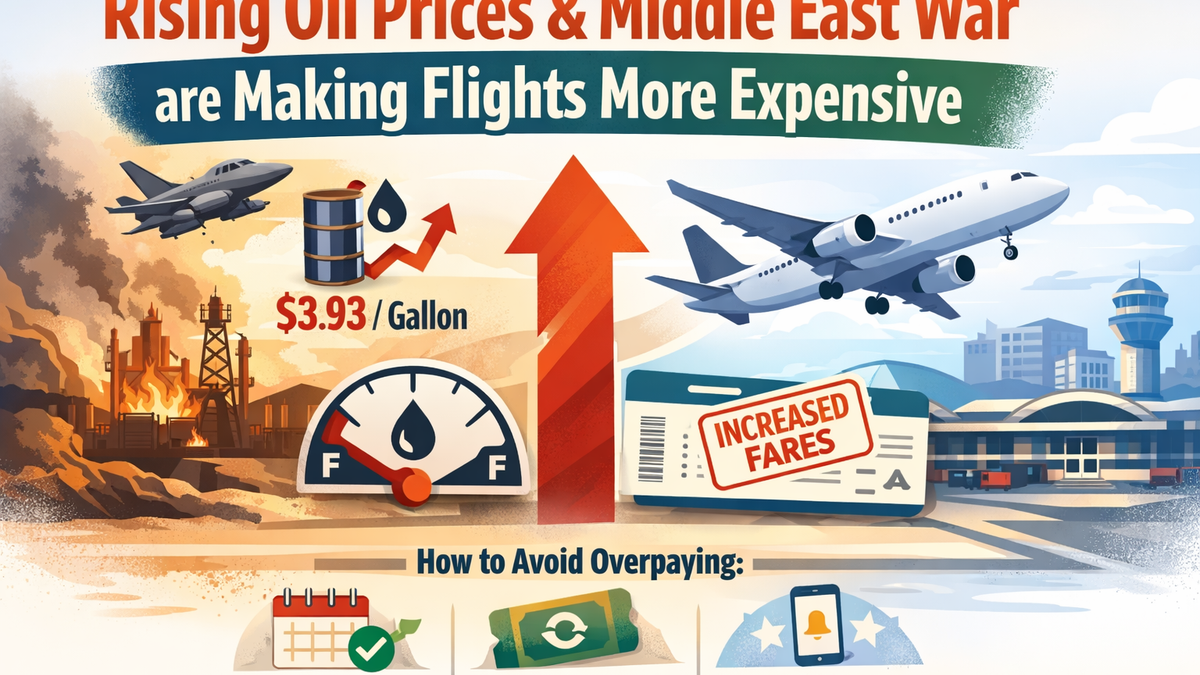
Before the U.S. and Israel launched strikes on Iran on February 28, 2026, a gallon of commercial jet fuel in the United States cost $2.50, according to Argus Media. By this week, that same gallon had risen to $3.93, an increase of more than 57% in under four weeks.[1]
At the start of 2026, jet fuel cost $2.11 per gallon according to the Argus U.S. Jet Fuel Index. By March 10th it had climbed to $3.40, a gain of more than 60% in barely two months. Separate data from S&P Global's Platts showed U.S. jet fuel reaching $3.78 per gallon by March 11, approaching levels not seen since Russia's 2022 invasion of Ukraine. The International Air Transport Association reported that global jet fuel prices climbed approximately 83% over the past month as of March 17.[2]
The cost of fueling just one Boeing 737-800 for a domestic route surged by nearly $10,000 in under a single week.[2]
Monday morning brought another dramatic swing. Brent crude rose to approximately $113 a barrel, the highest level since 2022, before falling roughly 8% after President Trump announced he was delaying his ultimatum to Iran following what he described as "productive" talks.[3] As of Monday afternoon, Brent remained around $101 a barrel even after the pullback, with Iran having denied the talks took place.[4]
The takeaway: even on a "good news" day for diplomacy, oil prices remain roughly 40% above pre-war levels. The volatility alone is a problem for airline planning.
Why This Is Not a Normal Oil Price Spike
The Strait of Hormuz, the narrow waterway through which roughly one-fifth of the world's oil and liquified natural gas supplies pass, has been effectively closed to normal traffic since early March.[5]
The International Energy Agency announced that member countries unanimously agreed to release 400 million barrels of oil from strategic reserves to ease prices, with the United States contributing 172 million barrels from the Strategic Petroleum Reserve. The moves failed to drive down the price of Brent crude, which remained above $100 a barrel.[6]
Freight analyst Peter Sand of Xeneta told CNN that transiting through the Strait of Hormuz is "completely off the charts for the rest of 2026" due to the uncertainty and security situation in the region. He said vessels are likely to steer clear of other major chokepoints including the Bab al-Mandab strait and the Suez Canal, with full rerouting of global shipping networks around the Cape of Good Hope possible for another year.[5]
Goldman Sachs on Friday suggested that high oil prices could last through 2027.[3]
Monday’s Diplomatic Developments and Why Volatility Remains the Story
As of Monday morning, the situation changed hour by hour. President Trump said Iran "called" to discuss resolving the war diplomatically, stating: "They want to make a deal, and we are very willing to make it."[7] Trump announced he was postponing "any and all military strikes against Iranian power plants and energy infrastructure" for five days.[8]
However, Iranian leaders have consistently denied reaching out to the U.S. with a ceasefire offer. Iran has responded to Trump's ultimatum by saying it will hit energy sites across the Middle East if its power facilities are targeted, and it has already fired hundreds of missiles and drones on Gulf countries targeting U.S. assets as well as energy facilities. Meanwhile, the Trump administration announced it is sending three more warships to the Middle East with about 2,500 additional Marines.[9]
For travelers, the honest assessment is this: whether a deal happens in five days or five months, US gas prices rose for the 23rd straight day Monday, reaching $3.96 in the latest reading from AAA, the highest price since August 2022.[5] Jet fuel follows crude oil. Structural cost pressure on airlines will not reverse overnight even if the Strait reopens.
What the Airlines Are Saying and Doing
Jet fuel typically makes up about a quarter of airline operating costs. The price for a gallon of jet fuel rose to $3.93 this week, up from $2.50 the day before the war broke out, according to Argus Media. Delta CEO Ed Bastian said that amounts to roughly $400 million in additional costs so far.[1]
American Airlines CEO Robert Isom, speaking at the JP Morgan Industrials Conference 2026, said: "Fuel prices have increased rapidly over the last few weeks. It has only been seven weeks since we reported earnings. What we have seen since that time is about a $400 million USD impact in terms of our first-quarter expenses." Isom also said he expects fuel costs to affect the airline's bottom line into the second quarter of 2026.[10]
United Airlines CEO Scott Kirby warned that fare increases will "probably happen very quickly." Cathay Pacific said it would roughly double its fuel surcharges on tickets starting March 18.[11]
From a review of several popular domestic routes, there are already signs the uptick in fares has begun. Data from Google Flights shows that the average price of airfares has already jumped on a number of popular domestic routes.[12]
Jefferies airline analyst Sheila Kahyaoglu said the most severe financial impact on airlines will likely arrive within the next 30 to 90 days. Airlines had already booked ticket revenue for near-term flights assuming much lower fuel prices and cannot retroactively raise fares on those existing reservations. That gap means forward-looking ticket prices will rise more aggressively to compensate.[2]
UBS analysts noted that because of airlines' upbeat outlooks on demand to start the year, "the environment is conducive for passing along fare increases."[11]
What Smart Travelers Should Do Right Now
If you have travel plans, one option is to wait out the recent price spike and hope prices decline after the initial shock; however, that may not be a great strategy if the conflict remains ongoing for many weeks or months. Instead, consider locking in prices today by booking your ticket in any class above basic economy (due to its many restrictions). In the event a flight price goes down, you could cancel and rebook at a lower rate, keeping either a credit or getting a refund of your original fare.[12]
The expert consensus is consistent: book now, book on a changeable fare, and have a plan for what happens if the price moves after you do.
That last part is where most travelers leave money behind.
The Part Most Travelers Miss: What Happens After You Book
Buying a changeable fare is the right call. But it only works if you actually notice when the price drops, navigate your airline's rebooking process before that lower fare disappears, and repeat the process every time it happens between now and your departure. In a market this volatile, where fares are moving on geopolitical headlines by the hour, manual monitoring is nearly impossible to sustain.
At pAiback, we've tracked qualifying price drops occurring up to 8 separate times on a single booking between the time we receive our user’s confirmation number and 24 hours before their departure. Each of those drops represented money a traveler was entitled to reclaim as an airline eCredit and would have missed without our automated monitoring solution.
The Points Guy described pAiback's approach this way: "This flight-refund tool uses artificial intelligence to monitor your flights and automatically issue refunds when prices drop. All you have to do is book directly with the airline and forward your confirmation email to pAiback. If the price drops, the pAiback team will work with the airline to get an eCredit deposited directly into your airline account."[13]
How pAiback Works, Crisis or No Crisis
This is the most important thing to understand: pAiback works exactly the same way regardless of what oil prices or geopolitics are doing.
The Middle East crisis has made fare volatility impossible to ignore. But prices have always moved after booking; driven by seat inventory, cancellations, competitive pricing, and demand patterns that have nothing to do with global events. Even in a rising-fare environment, individual flights still underperform booking targets. Inventory still opens. Routes still reprice. Automated monitoring doesn't stop finding savings because the macro environment is chaotic.
Getting started takes 60 seconds and requires no credit card:
1. Book your flight directly with American Airlines, Delta Air Lines, United Airlines, or Alaska Airlines, in Main Cabin or above. Do not book basic economy, as it is the most restrictive, and generally ineligible for fare adjustments.
2. Forward your confirmation email to ticketing@paiback.app, or connect your inbox for fully automatic detection.
3. pAiback monitors your fare around the clock, from confirmation receipt to 24 hours before departure, and automatically claims any qualifying price drop eCredits on your behalf. Your seat, flight, and confirmation number never change.
You keep 100% of the airline eCredit. pAiback earns a 20% convenience fee only when it saves you money. No savings, no fee.
The Bottom Line
Book early. Book on a changeable fare. Then let automation handle the rest.
Nobody knows when the Strait of Hormuz fully reopens. Nobody knows whether Monday morning's diplomatic signals hold or collapse by tonight. What is known: jet fuel is up more than 57% from pre-Middle East crisis levels even after this week’s oil price pullback. The 30-to-90-day window that Jefferies identified as the most acute financial impact period for airlines has arrived. Summer fare increases have already begun showing up on popular domestic routes.
The travelers who come out ahead won't be the ones who guessed right about oil prices. They'll be the ones who booked smart, bought changeable fares, and had automated monitoring in place to capture every eligible price drop between now and the day they fly.
Start tracking your flights for free at pAiback →
Sources
[1] PBS NewsHour — "Jet fuel prices and airfares are rising. U.S. airlines say travelers are still booking flights" — March 18, 2026 https://www.pbs.org/newshour/nation/jet-fuel-prices-and-airfares-are-rising-u-s-airlines-say-travelers-are-still-booking-flights
[2] TheStreet — "Jet Fuel Prices Jumped 60 Percent: Your Next Flight Will Cost More" — March 19, 2026https://www.thestreet.com/travel/jet-fuel-prices-jumped-60-percent-your-next-flight-will-cost-more
[3] U.S. News & World Report — "Trump Delays Iran Ultimatum Following 'Productive' Talks, Sending Oil Lower and Stock Futures Soaring" — March 23, 2026 https://www.usnews.com/news/national-news/articles/2026-03-23/trump-delays-iran-ultimatum-following-productive-talks-sending-oil-lower-and-stock-futures-soaring
[4] Bloomberg — "Markets Brace for Volatility as US-Iran War Escalates, Oil Prices Surge" — March 23, 2026https://www.bloomberg.com/news/articles/2026-03-22/markets-set-for-turbulent-open-as-war-rages-on-markets-wrap
[5] CNN Live Updates — "Iran War News, Trump Delays Strikes on Iranian Power Plants After 'Very Good' Talks with Tehran" — March 23, 2026 https://www.cnn.com/world/live-news/iran-war-us-israel-trump-03-23-26
[6] NBC News Live Blog — "No Relief From High Prices Despite Deal to Release Historic Amount of Petroleum Reserves" — March 12, 2026 https://www.nbcnews.com/world/iran/live-blog/live-updates-iran-war-israel-us-lebanon-tehran-oil-prices-hormuz-rcna262889
[7] NBC News Live Blog — "Trump Says He's Postponing Attacks on Iran Power Plants, Citing 'Productive' Talks to End War" — March 23, 2026 https://www.nbcnews.com/world/middle-east/live-blog/live-updates-iran-war-trump-hormuz-deadline-energy-crisis-gulf-power-rcna264685
[8] Euronews — "Oil Prices Slide After Trump Announces 'Productive Conversations' with Iran" — March 23, 2026https://www.euronews.com/business/2026/03/23/markets-tumble-as-oil-prices-climb-over-100-on-middle-east-conflict-fears
[9] Al Jazeera — "Trump's Changing Messages on Iran War: What Does It Say About US Strategy?" — March 22, 2026https://www.aljazeera.com/news/2026/3/22/trumps-changing-messages-on-iran-war-what-does-it-say-about-us-strategy
[10] TheStreet — "American Airlines CEO Gives Stark Warning About Fuel and Ticket Prices" — March 20, 2026https://www.thestreet.com/travel/american-airlines-ceo-gives-stark-warning-about-fuel-and-ticket-prices
[11] CNBC — "Flights Are Already Getting More Expensive After a Jet Fuel Spike. When Should You Book?" — March 12, 2026 https://www.cnbc.com/2026/03/12/airfare-prices-jet-fuel-iran-war.html
[12] TheStreet — "Rising Jet Fuel Costs Mean Higher Airfare Prices: Here's How to Save Your Summer Travel Plans" — March 9, 2026 https://www.thestreet.com/travel/rising-jet-fuel-costs-mean-higher-airfare-prices-how-to-save-your-travel-plans
[13] The Points Guy — "These New Tools Will Track Your Flights and Get You Refunds If the Price Drops"https://thepointsguy.com/news/fare-tracking-tools/
[14] Baker On Tech — "Paiback: The AI Travel Assistant That Gets You Money Back on Flights — Automatically" — July 23, 2025 https://bakerontech.com/paiback-the-ai-travel/
pAiback monitors booked flights on American Airlines, Delta, United, and Alaska Airlines and automatically secures airline eCredits when qualifying prices drop. No monthly fees. You pay nothing unless we save you money. Learn more at www.paiback.app.