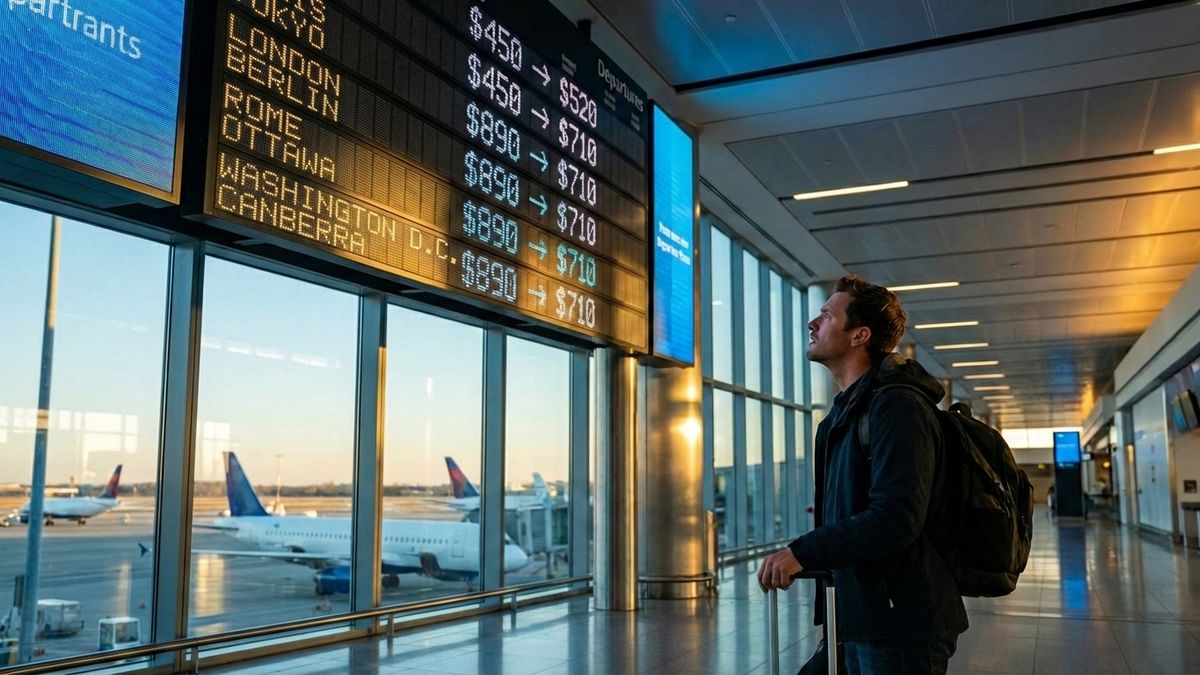
You book a flight. $347, Chicago to Denver. Solid fare, decent times, Main Cabin. You screenshot the confirmation and move on with your day.
Three days later, the same seat on the same flight is selling for $219.
Here's the thing: that $128 difference? It's yours. The airline will credit it to your loyalty wallet. They just won't tell you it happened.
Welcome to airfare in 2026. Prices are down. Volatility is up. And most travelers are leaving money on the table.
The Golden Age of Cheap Flights
Let's start with the good news. If you've been waiting for airfares to come back down, they have.
According to KAYAK's 2026 Travel Trends Forecast, domestic fares are down 3% and international fares are down 10% compared to last year [1]. The Bureau of Labor Statistics confirms it: airline fares fell 3.4% year-over-year in December 2025 [2].
Going, the flight deal service formerly known as Scott's Cheap Flights, calls this the "Golden Age of Cheap Flights." June 2025 was the second-cheapest month for airfare on record, adjusted for inflation [3].
After years of post-pandemic price spikes, the market has cooled. Capacity is up. Competition is stabilizing. Travelers are finally catching a break.
But here's what most people don't realize: favorable average prices don't mean stable prices.
258 Airlines. Real-Time AI. Prices That Change by the Hour.
The same technology that's bringing fares down is also making them wildly unpredictable.
By 2026, AI-driven pricing has become the industry standard [4]. Airlines no longer set fares manually or update them a few times a week. Algorithms process millions of data points in real time: load factors, competitor moves, booking window behaviors, even your search history.
The result? Ticket prices can change several times per day [5].
The traditional system used 26 fare "buckets" filed with ATPCO. Today, 258 carriers use some form of dynamic pricing [6]. Airlines like Lufthansa have been live with continuous pricing for over five years. United and Air France-KLM use "adjusted pricing" that can generate unlimited price points between those old buckets [7].
This is great when prices drop in your favor. The problem is you'll never know unless you're watching.
The K-Shaped Recovery
Here's where it gets interesting. While overall fares are down, the experience varies dramatically depending on how you fly.
Going's 2026 State of Travel report describes a "K-shaped divergence" in the industry [3]. Premium cabins are thriving. Airlines are investing heavily in business class, first class, and premium economy. Revenue from premium seats is growing faster than economy.
Meanwhile, budget travelers face fewer options. Ultra-low-cost carriers are consolidating. Allegiant and Sun Country announced a merger [8]. Basic Economy has become the default on many routes, with fewer full-fare Main Cabin seats available.
The airlines aren't competing on price anymore. They're competing on premium experience.
Economy isn't the product anymore. It's the fallback.
Loyalty Programs Under the Microscope
The Department of Transportation launched its first-ever industry-wide review of airline loyalty programs in 2025 [9]. American, Delta, Southwest, and United were all required to provide documentation on reward point devaluations, the average dollar value of a reward point, and information on dynamic pricing for redemptions.
The investigation is examining potential "unfair, deceptive, or anticompetitive practices" [10].
For frequent flyers, the scrutiny is long overdue. Over the past decade, most major programs shifted to revenue-based models. Miles are now tied to dollars spent, not miles flown. Status thresholds crept higher each year.
The good news? After years of increases, Delta, United, and American all kept elite status thresholds the same for the 2026 earning year [11]. Whether that's a sign of stabilization or just a pause before the next change remains to be seen.
The Alaska-Hawaiian Integration
One of the biggest shifts in 2026 is the completion of the Alaska Airlines and Hawaiian Airlines merger.
Alaska acquired Hawaiian for $1.9 billion in September 2024 [12]. By April 2026, the airlines will operate on a single reservation system. A new unified loyalty program, Atmos Rewards, combines the best of both programs [13].
For travelers, the integration means more routes, more redemption options, and Alaska's first widebody international flights to destinations like London and Rome.
It also means another layer of complexity. Alaska is discontinuing 16 routes in 2026 while adding 13 new ones [14]. Pricing on Hawaiian routes is being absorbed into Alaska's dynamic pricing system.
More options. More volatility. Same challenge: knowing when your fare drops.
Regulatory Whiplash
If you were counting on the government to protect you from volatile pricing, the landscape has shifted.
The DOT under the new administration has proposed revisions prioritizing warnings before financial penalties [15]. Mandates requiring airlines to provide meals and hotel accommodations during significant disruptions have been canceled. A policy requiring airlines to refund up to $775 for delayed or canceled flights has been reversed.
Some protections remain. Automatic refunds for bag fees and WiFi fees paid ahead of time are still in effect. Delayed baggage refunds kick in after 12 hours domestic, 15 hours international [16].
But the trend is clear: travelers are increasingly on their own.
What This Means for You
The 2026 airfare environment creates a strange paradox.
Prices are lower than they've been in years. But they change constantly. AI-driven systems adjust fares multiple times daily. Post-booking price drops are more common than ever.
And airlines have no obligation to tell you when your flight gets cheaper.
This is the gap pAiback was built to close.
We monitor your fare after you book. Every few hours, we check the price against live airline data. When it drops, we contact the airline, request a fare adjustment, and secure the credit for your loyalty wallet.
Same flight. Same seat. Same confirmation. Just less money.
You don't need to track prices. You don't need to call customer service. You don't need to understand each airline's change fee policy.
You just forward your confirmation email. We handle the rest.
The Math in 2026
With prices down but volatility up, post-booking price drops are happening more frequently. Our data shows 50-60% of flights experience at least one price drop after booking. The average savings when drops occur? $250 per ticket.
On a single booking, we've captured up to 8 separate price drops. On one trip, over $9,000 in total savings.
In a market where fares change by the hour, the traveler who monitors wins. The traveler who doesn't leaves money on the table.
The question isn't whether your flight will drop in price. It's whether you'll know when it does.
Fares are favorable. Volatility is at an all-time high. Let pAiback watch the price so you don't have to.
No savings. No fee.